
8 Lessons from EU Independent Filmmaking Beyond Celebrity Culture
At the 2026 edition of IndieLisboa International Independent Film Festival, one of the most striking discoveries was not simply films, but curatorial insights into independent filmmaking. As a press delegate attending on behalf of the Centre for Media and Celebrity Studies, I arrived expecting innovative independent cinema across geographies and genres. What I did not anticipate was how profoundly the festival’s curatorial lens of inquiry would invite audiences to re-think the foundations of spectatorship in their wider cultural practice of art. Co-funded by the Creative Europe MEDIA Programme, which supports independent cinema, European co-productions, and audience development, IndieLisboa panel talks and screenings offered the following 8 insights on how the cultural landscape of European filmmaking is a unique and sustainable alternative to systematic production models in Hollywood and Bollywood.
1. Sustainability and Alternative Film Ecosystems
Part of the wider Creative Europe ecosystem and connected to international networks, including Toronto International Film Festival, IndieLisboa positions itself not merely as a screening platform, but as a sustainable cultural alternative to the star-driven economies traditionally associated with Hollywood. The festival functions less as a commercial marketplace and more as a long-term cultural incubator centered on audience development, community growth, and sustained engagement with independent cinema. Rather than prioritizing transactional distribution models, IndieLisboa appears deeply invested in cultivating audiences who can support independent film culture over time. At the same time, Creative Europe MEDIA Programme encourages international co-productions with Portuguese production companies. Our own European co-productions and curations, backed up by celebrity studies research, offer further alternatives that strengthen the same focus on community, audience, and innovation on an international level.
2. Community Building and Audience Development
This commitment becomes visible throughout the in-person festival experience at. IndieLisboa. It is not only about films on screens; it is about building relationships between artists, audiences, educators, children, researchers, and local communities across the city of Lisbon. Through workshops, talks, public gatherings, and participatory events, cinema becomes a shared social practice. Audience building here is not an afterthought but a central part of how independent film culture is sustained.
3. Creativity and Imagination
Particularly impressive is the festival’s investment in nurturing future generations of viewers and creators. Its children’s programming reportedly welcomes nearly 10,000 children, transforming cinema into an early educational and creative encounter rather than an elite cultural activity. Partnerships with schools encourage experimentation, imagination, and artistic exploration, while collaborations with universities extend these conversations into broader public intellectual and cultural contexts
4. Innovation –Baby Cinema
The festival’s Baby Cinema category became especially fascinating. The concept initially appears playful: films designed for babies and very young audiences. Yet beneath that premise lies a profound question about how human beings first encounter images, sounds, emotions, and collective viewing experiences. The section challenges assumptions about spectatorship and invites us to reconsider the origins of cinematic engagement itself. What makes Baby Cinema particularly compelling is the safe and multisensory environment it creates. Cinema here becomes tactile, emotional, auditory, and communal. Observing how babies engage with moving images raises broader questions about how future generations will receive stories, participate in media culture, and develop creative expression. It shifts attention away from commercial visibility and toward the formation of imagination itself. Rather than treating cinema solely as entertainment, IndieLisboa presents it as a tool for learning, curiosity, and creative citizenship.
5. Accessibility and Inclusion
The festival’s accessibility initiatives further reinforce its social mission. The inclusion of sign language interpretation and programming attentive to diverse audiences reflects an understanding that participation in culture should be as important as representation within it. These efforts create a more inclusive environment in which a wider range of communities can engage with independent cinema.
Beyond screenings, IndieLisboa, in general, promotes a broader understanding of film culture through discussions and training related to sustainability, diversity, mental health, and cybersecurity. Such initiatives recognize that contemporary filmmaking exists within social and technological ecosystems that require care, awareness, and responsibility. The festival therefore supports not only artistic development but also the cultivation of ethical and resilient cultural practices.
6. Producing Beyond Celebrity Culture
Contemporary celebrity culture often depends on visibility, performance, and accelerated circulation, as historically seen in Hollywood film stardom, IndieLisboa, by contrast, appears invested in cultivating imagination, care, reflection, and community. In doing so, it offers an alternative cultural framework that extends beyond the tabloid politics of fame. Coming from the field of celebrity studies—a discipline that traces fame from ancient Greek and Roman heroic traditions to today’s digital media stars—I found this contrast especially meaningful for the current and next generation of cinematic storytellers.
7. Local Roots, Global Networks
Equally important is the way the festival network extends beyond Lisbon itself. Through broader European cultural networks and regional initiatives, IndieLisboa helps bring cinema into surrounding communities and countryside locations beyond the festival schedule. The international festival thereby embodies a philosophy of being “local to become global”—rooted in place while fostering collaborations, networks, and associations across Europe and beyond.
8. Artistic Diversity and Cultural Expression
There is also a visible commitment to supporting artistic forms often overshadowed by mainstream commercial cinema, particularly animation and experimental work. Rather than reproducing dominant industry formulas, the festival creates space for alternative forms of storytelling, aesthetic exploration, and cultural expression.
The Future of Independent Cinema
In an era where individual attention itself has become commodified, IndieLisboa reminds us that cinema can still function as a civic and cultural commons. Through its commitments to sustainability, inclusion, education, audience development, and intergenerational creativity, the festival offers more than a showcase of films. It presents a vision of what a healthier and more sustainable global film culture might look like—one built not around stardom, but around communities of imagination.
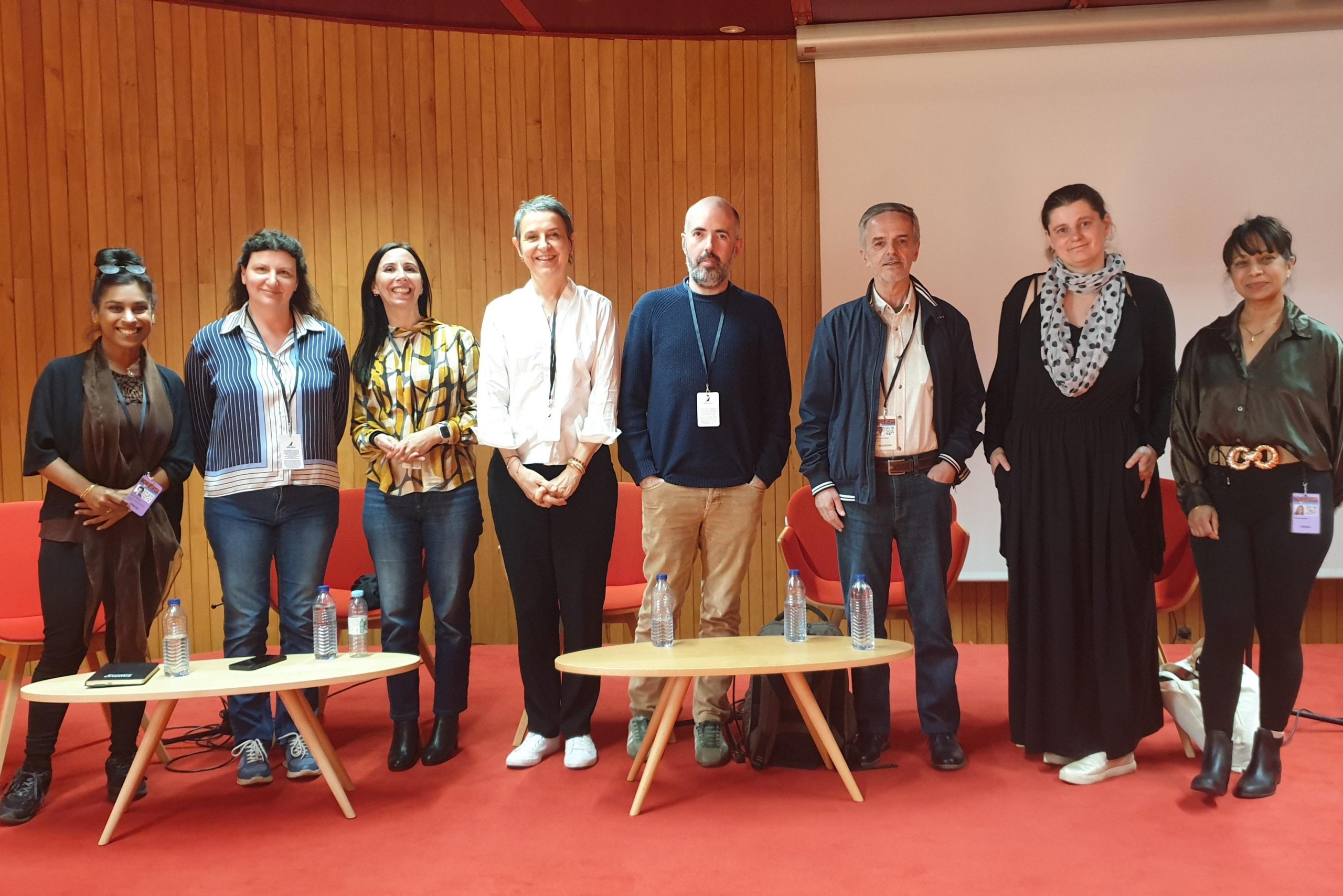
Special thanks to press delegate Varsha Mehra for the CMCS photography.
Featured Publications and Call for Papers (Archives)
From Claire Spence (Taylor & Francis Group)

Routledge is very proud to present the Media Focus collection, a series of carefully selected articles examining the impact of various elements of modern culture. Part one investigates the influence, power and reach of Celebrities.
In a world where Twitter, Instagram and gossip blogs instantly inform us of the whereabouts and what’s happenings of celebrities we look at the impact of Celebrity. The first element in our Media Focus collection will examine the various facets of celebrity culture.
Which celebrities have used their influence for humanitarian causes? How fleeting is celebrity? Which celebrities have capitalised on their fifteen minutes? Find the answers below.
Celebrity
- Writing the celebrity pseudo-autobiography: hauntings in Ellis and Ellroy
- Continuum
- Siobhan Lyons
- White stars and orange celebrities: the affective production of whiteness in humorous celebrity-gossip blogs
- Celebrity Studies
- Anne Graefer
- Animal celebrities
- Celebrity Studies
- David C. Giles
- Star/poverty space: the making of the ‘development celebrity’
- Celebrity Studies
- Michael K. Goodman & Christine Barnes
- The celebrity influence: do people really care what they think?
- Celebrity Studies
- Valerie R. O’Regan
- Medusa’s stare: celebrity, subjectivity and gender
- Celebrity Studies
- Tim Edwards
- Guess who Tiger is having sex with now? Celebrity sex and the framing of the moral high ground
- Celebrity Studies
- Hilde Van Den Bulck & Nathalie Claessens
- Nothing less than perfect: female celebrity, ageing and hyper-scrutiny in the gossip industry
- Celebrity Studies
- Kirsty Fairclough
- Corey Haim and the ‘homeless celebrity’: rock bottom on Rodeo Drive
- Celebrity Studies
- Pansy Duncan
- A Phantasmic Experience: Narrative Connection of Dead Celebrities in Advertisements
- Culture, Theory and Critique
- Kasey Clawson Hudak
- Kylie will be ok: On the (im-)possibility of Australian celebrity studies
- Cultural Studies
- Frances Bonner
- Stars Behaving Badly: Inequality and transgression in celebrity culture
- Feminist Media Studies
- Lieve Gies
- Fiercely Real?: Tyra Banks and the making of new media celebrity
- Feminist Media Studies
- Jessalynn Marie Keller
- Not “Simply the Breast”: Media discourses of celebrity, breastfeeding, and normalcy
- Feminist Media Studies
- Spring-Serenity Duvall
- “Check On It”: Beyoncé, Southern booty, and Black femininities in music video
- Feminist Media Studies
- Aisha Durham
- Opening Pandora’s Box: pleasure, consent and consequence in the production and circulation of celebrity sex videos
- Porn Studies
- Philip Hayward & Alison Rahn
- Effects of celebrity involvement on young people’s political and civic engagement
- Chinese Journal of Communication
- Nainan Wen & Di Cui
- The Theatricality of Humanitarianism: A Critique of Celebrity Advocacy
- Communication and Critical/Cultural Studies
- Lilie Chouliaraki
- Gender, Media, and Madness: Reading a Rhetoric of Women in Crisis Through Foucauldian Theory
- Review of Communication
- Michaela D. E. Meyer, Amy M. Fallah & Megan M. Wood
- Nudity, celebrity and women abuse: Marie Claire’s 2009 ‘The Naked Issue’ edition
- Communicatio: South African Journal for Communication Theory and Research
- Koen Panis & Hilde Van Den Bulck
|
- Celebrity Suicide and the Search for the Moral High Ground: Comparing Frames in Media and Audience Discussions of the Death of a Flemish Celebrity
- Critical Studies in Media Communication
- Hilde Van den Bulck & Nathalie Claessens

OBERTO CONFERENCE 2015: Opera and Celebrity
Oxford Brookes University
Tuesday 8 September 2015
From the castrati of the 18th century and the prima donnas of the 19th century to the star singers of the present day, opera has long been associated with celebrity culture. Although operatic celebrities were never just famous for being famous, many performers – and more recently also some composers and directors – were fêted or notorious for more than their artistic achievements. From the earliest days of public opera, accounts of singers’ love affairs, spectacular feuds or personal antics were eagerly lapped up by audiences that looked to the opera for entertainment both on and off the stage. The advent of mass media culture in the later 19th century, however, offered singers and their agents new and powerful promotional tools, which many embraced with enthusiasm. Singers such as Melba and Caruso commanded extravagant fees and were treated like royalty. The opera house also acted as a magnet for celebrities from other walks of life, seeking to enhance their public image via the cultural cachet and glamour factor of opera. During the 20th century audiences and critics became somewhat less tolerant of earlier models of operatic ‘star behaviour’ and in the present day operatic stars might appear to have been comprehensively eclipsed by new and very different types of celebrity. However, studies such as Claudio E. Benzecry’s The Opera Fanatic have demonstrated that contemporary opera enthusiasts are as obsessive about individual singers as they ever were.
This conference, organised by the OBERTO opera research unit at Oxford Brookes University, aims to examine the ways in which operatic celebrities across the centuries have promoted themselves and been received by audiences, as well as exploring the impact stars have had upon operatic works and productions. The conference will include a special session on opera and celebrity during the interwar period, associated with Dr Alexandra Wilson’s British Academy-sponsored project on British operatic culture in the 1920s. However, the conference as a whole will engage with all historical periods and a wide array of geographical areas. We also invite contributions on the place of operatic stardom within changing models of celebrity culture in the early twenty-first century.
Topics might include (but are not restricted to):
- The star as god vs. the star as commodity
- Celebrity lifestyles and morality
- The impact of the ‘star’ on operatic works and productions
- Celebrity and life writing
- Opera singers in films
- Celebrity and image / portraiture
- The travelling / trans-Atlantic celebrity
- Operatic fandom past and present
- Critical responses to operatic stars
- Celebrity appropriation of the operatic environment
- Operatic celebrity during the interwar period
We invite proposals for 20-minute presentations, panel discussions and alternative format sessions such as lecture-recitals or poster presentations. We welcome contributions not only from academics but also from performers and opera industry or media professionals. Past OBERTO conferences have facilitated lively debates between academics, practitioners and members of the general public, and we would like to continue this tradition.
Please send abstracts of no more than 250 words to Dr Alexandra Wilson at alexandra.wilson@brookes.ac.uk by Monday, 1 June 2015.
The conference will take place at Oxford Brookes University on Tuesday, 8 September 2015.
 OBERTO holds an annual conference every September. For details and reports of previous conferences, please see here.
CFP: Childhood and Celebrity
Please see this CFP from John Mercer and Jane O´Connor:
Jane O’Connor and John Mercer are editing a collection of essays for an anthology on Childhood and Celebrity. There is a final space in the collection that we are hoping to fill with an essay on the subject of children or teenage bloggers/ vloggers/ youtube celebrities. Could any colleagues who are researching in this area, would like to submit an essay on this subject or could recommend a potential author please let Jane or John know via email.
Thanks.
Dr John Mercer
Reader in Gender and Sexuality
Programme Leader Media and Cultural Research Degrees
Birmingham School of Media
Birmingham City University
Room MP 345
The Parkside Building
5 Cardigan Street
Birmingham
B4 7BD
+44 121 331 5719
john.mercer@bcu.ac.uk
- DAVID BOWIE: CRITICAL PERSPECTIVES
Edited by Eoin Devereux, Aileen Dillane and Martin J. Power. Published by Routledge.
David Bowie: Critical Perspectives examines in detail the many layers of one of the most intriguing and influential icons in popular culture. This interdisciplinary book brings together established and emerging scholars from a wide variety of backgrounds, including musicology, sociology, art history, literary theory, philosophy, politics, film studies and media studies. Bowie’s complexity as a singer, songwriter, producer, performer, actor and artist demands that any critical engagement with his overall work must be interdisciplinary and wide-ranging in its scope. The chapters are organised around the key themes of ‘textualities’, ‘psychologies’, ‘orientalisms’, ‘art and agency’ and ‘performing and influencing’ in Bowie’s work. This comprehensive book contributes a great deal to the study of popular music, performance, gender, religion, popular media and celebrity.
Introduction: Where Are We Now? Contemporary Scholarship on David Bowie Eoin Devereux, Aileen Dillane and Martin J. Power Part 1: Assemblages 1. David Bowie is. Kathryn Johnson 2. In this Age of Grand Allusion: Bowie, Nihilism, and Meaning Richard Fitch 3. Culminating Sounds and (En)visions: A Critical Reading of Bowie’s “Ashes to Ashes.” Eoin Devereux, Aileen Dillane, and Martin J. Power Part 2: Subjectivities 4. Turn Myself to Face Me: David Bowie in the 1990s and the Discovery of the Authentic Self Bethany Usher and Stephanie Fremaux 5. ‘Crashing Out with Sylvian’: David Bowie, Carl Jung and the Unconscious Tanja Stark 6.Dear Dr. Freud: David Bowie Hits the Couch (A Psychoanalytical Approach) Ana Leone Part 3: Orientalisms 7.Moss Garden: David Bowie and Japonism in Fashion in the 1970s Helene Thian 8. Reconsidering Bowie in the 1980s: The Case for China Girl Shelton Waldrep 9.Embodying Stardom, Representing Otherness: David Bowie in ‘Merry Christmas Mr. Lawrence’ Mehdi Derfoufi Part 4: Agencies 10. Art’s Filthy Lesson Tiffany Naiman 11. Authorship, Agency, and Visual Analysis: Reading (some) Bowie Album Covers Ian Chapman 12. Revisiting Bowie’s Berlin David Buckley Part 5: Alterities 13. David Bowie: The Extraordinary Rock Star as Film Star Julie LobalzoWright 14. The (becoming-wo)Man Who Fell to Earth Dene October 15. Out of this World: Ziggy Stardust and the Spatial Interplay of Lyrics, Vocals, and Performance Barish Ali and Heidi Wallace Part 6: Affinities 16. David Bowie Now and Then: Questions of Fandom and Late Style Nick Stevenson 17. How Superficial!: David Bowie and the Art of Surfacing in 21st Century Literature Vanessa Garcia
- A Genre Approach to Celebrity Politics (2015)
By Nahuel Ribke (Tel Aviv University). Published by Palgrave MacMillan
The study of celebrities has been the focus of several works from two main fields: Cultural Studies and Political Communication. But up until now, such works have produced only fragmented views of links between celebrity culture, the entertainment industries, and the political systems, which this book attempts to transcend. Analyzing the movement of celebrities to politics, this book contributes to a thorough understanding of the links between media industries and the political system, providing tools for grasping the varied ways in which media capital is converted into electoral power. To achieve this goal, Nahuel Ribke has assembled a wide range of data from the United States, Brazil and Israel, providing a complex comparative view of the migration of celebrities to politics, which incorporates a historical and cultural
analysis, an examination of the respective political institutions, as well as an understanding of the impact local cultural industries had on the development of celebrity politics.
Further information available here:
http://www.palgrave.com/page/detail/A-Genre-Approach-to-Celebrity-Politics/?
K=9781137409386
- CFP: “Heroes in Popular Culture” MPCA / ACA Conference
Papers can explore any topic relating to heroes and/or prevailing notions of heroism as they present themselves in popular culture. Topics may include, but are not limited to:
-Superheroes and action stars as heroic icons
-Video games and the experience of vicarious/learned heroism
-Connections between violence and heroism
-The gendering of heroism
-Heroines in young adult fiction
-Anti-heroes in media
-Pop culture heroes and religion/mythology
-Hero worship
-Real world heroes in the news and biographies
Please upload 250 word abstract proposals on any aspect of Heroes in Popular Culture to the Heroes in Popular Culture area, http://submissions.mpcaaca.org/.
Any questions? Please email Jef Burnham at jefburnham@gmail.com,
More information about the conference can be found at http://mpcaaca.org/
Please note the availability of graduate student travel grants: http://mpcaaca.org/conference/travel-grants/.
Please include name, affiliation, and e-mail address with the 250 word abstract. Also, please indicate in your submission whether your presentation will require an LCD Projector.
Jef Burnham, DePaul University
Email: jefburnham@gmail.com
Visit the website at http://mpcaaca.org
From Sarah Taylor-Harman
- Call For Papers: Fifty Shades of Grey (2015)
The cinematic release of Jamie Dornan Fifty Shades of Grey (2015) has already garnered speculation, derision and debate equal to its highly controversial source text, E. L. James’ homonymous trilogy. Its alignment with mass media, a predominantly female audience and mainstream cinema make it a concurrently anticipated and abhorred rich contemporary text. Intensities: The Journal of Cult Media thus invites papers which will interrogate this adaptation from a plethora of new perspectives including industry, text and reception analysis.
Focuses may include, but are not limited to:
* Adaptation Studies
* Audience Studies
* Comparative film analyses
* Criticism analyses
* Genre and Formalism
* Fans and Fan-Fiction
* Kink, BDSM and Sexual Politics
* Publicity, promotion and paratexts
* Psychoanalytic textual analysis
* Queer Theory
* Social Networking and the Blogosphere
* Star Studies
Authors are expected to familiarise themselves both with the pre-existing literature on Fifty Shades, and with the submission guidelines available at:
http://intensitiescultmedia.com/about-intensities/submission-guidelines/
Considering the timeliness of this topic, the deadline for submissions of full 6-8k papers accompanied by 250 word abstracts and 150 word bios is April 30th 2015 for publication this year. Submissions should be emailed to assistant editor Sarah Taylor-Harman at Sarah.Harman@brunel.ac.uk.
Inquiries and expressions of interest are also welcomed.
Sarah Taylor-Harman
PhD Candidate, Brunel University Screen Media Research Department
https://brunel.academia.edu/SarahTaylorHarman/
- Call for Papers – Mediated Autoethnography: Connecting the
Personal and the Popular
A special issue of The Popular Culture Studies Journal, co-edited by
Jimmie Manning and Tony Adams.
The Popular Culture Studies Journal invites submissions for a 2015 theme
issue that will explore connections between autoethnography and popular
culture. In addition to full-length manuscripts, the editors are also
open to receiving shorter commentaries on method, practice, and/or theory.
Drawing from Carolyn Ellis’s articulation, autoethnography is
scholarship involving “research, writing, story” and a method that
connects “the autobiographical and personal to the cultural, social, and
political” (The Ethnographic I, xix). The personal, cultural, social,
and political elements of autoethnography certainly link to popular
culture. As Herrmann astutely notes, “Popular culture helps us define
who we are, what we believe, and influences whom we befriend” (“Daniel
Amos and Me,” 7). Indeed, people not only connect with popular culture
entities, but they even see themselves in popular culture texts
(Manning, “Finding Yourself in Mad Men”; Stern, “My So-Called Felicity
and the City”).
Ideal manuscripts will make a strong contribution to understanding
social life as it interacts with popular culture; offer meaningful,
complex, and evocative texts that reflexively articulate the author’s
engagement with the writing process; and express an emotional, embodied
sense of personal experience and popular culture. We especially welcome
submissions that contribute to what we hope will be a tapestry of voices
from diverse cultural backgrounds. Possible topics or approaches could
include the following:
-Articulations of how popular culture influenced or was/is an integral
part of meaningful lived experience
-Essays exploring the way identities can be seen or not seen in popular
culture
-Critical inquiries about race, class, gender, or sexuality in popular
culture
-The development or redevelopment of autoethnographic methods for use
with popular culture studies
-Connections between popular culture representations and personal
experiences, especially as they inform theoretical understandings of
identity and/or relationships
Manuscripts should be sent to both special issue editors as a Microsoft
Word document. In line with the journal’s regular submission criteria,
two files should be included. The first file should include a single
title page containing complete contact information (address, phone
number, e-mail address). The second file should also include a title
page with only the article’s title and no author information. The
journal employs a “double blind review” process.
Full-length essays should be less than 25 pages of double-spaced text in
12 pt. Times New Roman font, including all images, endnotes, and Works
Cited pages. Shorter think pieces of 7-12 pages will be accepted for
this special issue only. Research and documentation must adhere to The
MLA Handbook for Writers of Research Papers which requires a Works Cited
list and parenthetical author/page references in the text.
Please send all essays by May 15, 2015 to the editors of this special
issue, Jimmie Manning (jman@niu.edu <mailto:jman@niu.edu>) and Tony
Adams (aeadams3@neiu.edu <mailto:aeadams3@neiu.edu>). Questions may also
be directed to those email addresses. ===== General list info and FAQ:
http://comm.umn.edu/~grodman/cultstud.html
From Margaret Redlich at mredlich21@gmail.com
- Call for Papers Midwest Popular Culture Association Annual Conference 2015
October. 1-4
Cincinnati, OH
Submission Deadline: May 15, 2015
Bollywood comes to Ohio!
Do you have deep thoughts on Shahrukh Khan? How about Yo Yo Honey Singh or Balaji soaps? Or the recent re-imagining of the Mahabharata on TV? Talks on any and all topics related to Indian popular culture are welcome! Just submit a brief abstract to the website above.
Please submit abstracts to http://submissions.mpcaaca.org
If you have any questions, please contact Margaret Redlich at mredlich21@gmail.com
Living Life in Public: Exploring the Private Lives of Celebrities
The Celebrity Project: 4th Global MeetingTuesday 28th July – Thursday 30th July 2015
Mansfield College, Oxford, United Kingdom From Dr Jackie Raphael, IDP Steering Group and CMCS Advisory Board Member
Call for Presentations:
Celebrities are “well-known” individuals who either by choice or by chance have achieved renown or infamy outside of personal and professional circles. Despite complaints that celebrities routinely make of the inconveniences of fame, many devote considerable resources to retaining and increasing their visibility, and to crafting their public images. Despite the very public nature of the celebrity, what drives much mass interest in these rarefied individuals is very often their private lives. Personal scandals can wreck (or in some cases, even propel) celebrity success, and avoiding, managing and atoning for scandal consists of a large part of maintaining a career in public. Many celebrities are also astute in utilising private life events such as weddings and childbirth and personal struggles with failure, addiction and romantic disappointment to make their public images more compelling.The sector of media devoted to covering celebrities’ private lives is a gigantic one, with “candid” photographs of Britney Spears, David Beckham or Justin Bieber fetching huge sums. The romantic lives of well-known star couples, like Kanye West and Kim Kardashian (“Kimye”), Ellen DeGeneres and Portia Rossi, and on and off-screen lovers Kristen Stewart and Robert Pattinson of Twilight fame receive ink rivaling their creative outputs. Sport figures like Lance Armstrong and Oscar Pistorius who reap the benefits of their compelling personal stories must also face the abyss of doping scandals and murder charges. The explosion of reality television has introduced a new wrinkle as participants in internationally syndicated shows like The Bachelor, Real Housewives and Big Brother gain tabloid space not for achievements in sports, politics and the arts but for the ways in which they perform versions of their own romantic, domestic and professional lives. Exposing one’s private life appears to be trumping public achievement as a means for achieving renown. This, of course, is not just a Western phenomenon, and well known figures from Asian and African music and cinema equally utilse performances of their private lives to inform their public persona.Why this obsession with celebrities’ private lives? This question offers a ripe opportunity to investigate the cultural, historical and philosophical categories of public, private, and of celebrity itself. Scholars, artists, fans, writers, lawyers, media professionals, performers, even celebrities are invited to send papers, reports, personal narratives, research studies, works-in-progress, works of art, and workshop proposals on issues related but not limited to the following themes, as they may manifest themselves in multiple historical and geographic locations:– Paparazzi and the celebrity press, gossip, lifestyle, home shows, articles, and websites
– Celebrity bodies, plastic surgery, weight gain or loss, death and dying
– Celebrity self-commodification of personal lives: romance, tragedy, hardships, addictions, comebacks, pregnancies, etc.
– Scandal, crisis management, public shaming and remorse, redemption and penance campaigns
– Race and gender representation and celebrity, realness, whiteness, celebrities of colour and mixed race, masculinity and femininity, affirmative action and tokenism, celebrities and disability
– LGBT celebrities, coming out, outing and closeting, gay rumours and innuendo, gay marriage, gender transitions, homophobia and its career impact
– Personal life and image management, sham or hidden relationships and marriages, synergistic relationships (Brangelina, Bennifer, Kimye)
– Reality stars and reality television, YouTube celebrities, talent competitions, beauty contests, internet memes based on traditional and internet celebrities
– Royalty as celebrity, succession crises, royal scandals, pregnancies, ceremony and ritual, republican critics of royalty.
– Celebrity athletes, personal narratives, inspirational stories, scandals, sportsmanship, club affiliations, on-field and locker room interviews
– Celebrity and the law: celebrity crime, paternity suits, libel suits, invasion of privacy, etc.
– Private life as a source of artistic inspiration and validation for celebrities
– Celebrity autobiographies, self-help books, addiction narratives, and exposees.
– Personal narratives, confessional poetry, lyrics and prose, self-exposure as a creative trope
– Hip Hop personas and personal narratives, boasting and fronting, players vs. haters, realness, hypermasculinity, race, gender and linguistic diversity
– “Method” acting, bodily modification, use of private emotion, spontaneity in performance
– Religion and celebrity, public and private expressions of faith, personal and professional religiosity, celebrities with non-mainstream or New Age faiths
– Celebrities and politics, public endorsements, private support, reaction to social controversies
– Children of celebrities, child celebrities, and celebrity dynasties
– Fandom, collecting autographs and memorabilia, relationships between fans and celebrities real or imagined, erotic fiction featuring celebrities, cosplay, memorials and tributes
– Conventions, tours, personal appearances, award shows, red carpets, acceptance speeches.
– Celebrity biopics, accuracy vs. dramatic license in depictions of private lives, performing celebrity, casting and mimicry, celebrity impersonators, celebrity parodies
– Celebrities and social media, Facebook, Pinterest, and Twitter followers, posts, and mishapsThe Steering Group welcomes the submission of proposals for short workshops, practitioner-based activities, performances, and pre-formed panels. We particularly welcome short film screenings; photographic essays; installations; interactive talks and alternative presentation styles that encourage engagement.What to Send:
Proposals will also be considered on any related theme. 300 word proposals should be submitted by Friday 1st May 2015. If a proposal is accepted for the conference, a full draft paper of no more than 3000 words should be submitted by Friday 19th June 2015. Proposals should be submitted simultaneously to both Organising Chairs; abstracts may be in Word or RTF formats with the following information and in this order:a) author(s), b) affiliation as you would like it to appear in programme, c) email address, d) title of proposal, e) body of proposal, f) up to 10 keywords.
E-mails should be entitled: Celebrity4 Proposal Submission.Please use plain text (Times Roman 12) and abstain from using footnotes and any special formatting, characters or emphasis (such as bold, italics or underline). We acknowledge receipt and answer to all proposals submitted. If you do not receive a reply from us in a week you should assume we did not receive your proposal; it might be lost in cyberspace! We suggest, then, to look for an alternative electronic route or resend.Organising Chairs:
Jon Torn: jonleontorn@gmail.com
Rob Fisher: celeb4@inter-disciplinary.netThe conference is part of the Critical Issues series of research projects. The aim of the conference is to bring together people from different areas and interests to share ideas and explore various discussions which are innovative and exciting.All proposals accepted for and presented at the conference must be in English and will be eligible for publication in an ISBN eBook. Selected proposals may be developed for publication in a themed hard copy volume(s). All publications from the conference will require editors, to be chosen from interested delegates from the conference.Inter-Disciplinary.Net believes it is a mark of personal courtesy and professional respect to your colleagues that all delegates should attend for the full duration of the meeting. If you are unable to make this commitment, please do not submit an abstract for presentation.Please note: Inter-Disciplinary.Net is a not-for-profit network and we are not in a position to be able to assist with conference travel or subsistence.Conference URL: http://www.inter-disciplinary.net/critical-issues/ethos/celebrity-exploring-critical-issues/call-for-papers/
_____________________________________________________
Call for Papers: “Performing Stardom”: New Methods in Critical Star StudiesFriday 29th May, 2015NoRMMA (Network of Research: Movies, Magazines, Audiences), University of Kent, UKNoRMMA invites proposals for an interdisciplinary conference on non-traditional approaches to star studies research. The one-day event will be held at the University of Kent on May 29th, 2015.Confirmed keynotes:Dr Catherine Grant, University of SussexDr Kieran Fenby-Hulse, Bath Spa UniversityThe event will focus on ways to explore film studies research through non-traditional approaches. Examples include: performance, video essays, interpretative dance, creative fiction/non-fiction, poetry, music, and any kind of multimedia project. Through this symposium, we would like to explore the connections between scholarship and fandom, research and creativity, the benefits and disadvantages of exploring an (audio)visual art through (audio)visual means, and the development of the innovative and ever-emerging field of practice as research.Potential topics include, but are not limited to:– Star studies– Film History– Fan magazine research– Audience reception studies– Archival research– Genre studies– Aspects of film analysisPotential contributors should submit abstracts of 300 words and a short biography to normma.network@gmail.com by Friday 27th February, 2015.
_________________________________________________________
Public Culture Special Issue “Celebrities and Publics in the Internet Era
On the occasion of the publication of “Celebrities and Publics in the Internet Era,” Public Culture and the Institute for Public Knowledge led a discussion with contributing authors Sharon Marcus, Alice Marwick, Susan Murray, and Dana Polan. The event was moderated by Terri Senft and followed by a reception with the authors.“Celebrities and Publics in the Internet Era,” a special issue of Public Culture guest edited by Sharon Marcus, asks how new digital media platforms such as search engines, Twitter, Facebook, Instagram, GIFs, and YouTube have qualitatively changed celebrity culture. Drawing on a wide range of examples, from the luxury selfies of microcelebrities like Kane Lim to performance artist Marina Marina Abramović’s collaborations with Jay-Z and Lady Gaga, from the karaoke standard in shows like American Idol to Syrian singer Assala’s media battle with the Assad regime, from the “emotion economy” of reality TV to the influence of network entrepreneurs like Tim O’Reilly, the essays in this special issue identify core structural features that contribute to the development of a new theory of celebrity.
Sharon Marcus is Dean of Humanities and the Orlando Harriman Professor of English and Comparative Literature at Columbia University. She is the author of Apartment Stories: City and Home in Nineteenth-Century Paris and London (University of California Press, 1999), and the prize-winning Between Women: Friendship, Desire, and Marriage in Victorian England (Princeton, 2007). In 2009, with Stephen Best, she edited a special issue of Representations on “The Way We Read Now.” A founder and Co-Editor in Chief of Public Books, she is currently finishing a book about theatrical celebrity in the nineteenth century.Alice Marwick is an Assistant Professor of Communication and Media Studies, Director of the McGannon Communication Research Center at Fordham University, and an academic affiliate at the Center for Law and Information Policy at Fordham Law School. Her work examines the impact of the large audiences made possible by social media on individuals and communities from a social, cultural, and legal perspective. She is the author of Status Update: Celebrity, Publicity and Branding in the Social Media Age (Yale, 2013). Current research interests include online privacy practices, the changing nature of self-presentation, and gender, feminism and social media.Susan Murray is Associate Professor of Media, Culture and Communication at NYU. She is the author of Hitch Your Antenna to the Stars: Early Television and Broadcast Stardom (Routledge, 2005) and a co-editor, with Laurie Ouellette, of two editions of Reality TV: Remaking Television Culture (NYU Press, 2004; 2009). She is currently working on Brought to You In Living Color: A Cultural History of Color Television, a book project under contract with Duke University Press and supported by fellowships from the NEH, ACLS, and The Humanities Initiative at NYU.Dana Polan is a Professor of Cinema Studies at New York University. He is the author of 8 books in film and media and approximately 200 essays, reviews, and review-essays. Two of the books are in Duke University Press’s series, Spin-offs, on individual television shows: one on The Sopranos, one on Julia Child’s The French Chef. Polan is a former president of the Society for Cinema Studies, the professional society for film, and a former editor of its publication, Cinema Journal. He has been knighted by the French Ministry of Culture for contributions to cross-cultural exchange, and in 2003, he was selected as one of that year’s two Academy Foundation Scholars by the Academy of Motion Picture Arts and Sciences.Terri Senft teaches in the Global Liberal Studies Program at New York University. Her writing focuses on how digital technologies shift cultural notions of the private, the public, the pedagogic and the pornographic. Terri is the author of Camgirls: Celebrity & Community in the Age of Social Networks, co-editor of The Routledge Handbook of Social Media, currently co-editing a special section on “selfies” for the International Journal of Communication, and writing a monograph titled Fame to Fifteen: Social Media and the Micro-Celebrity Moment. Terri has written for The New York Times, and spoken at venues including Arcadia Missa/The Institute of Contemporary Art, TED Salon London, Saatchi & Saatchi. She also featured in the award-winning documentary Webcam Girls.The date and location of this event was:Friday, February 13, 2015
6:00 pm – 8:00 pm
20 Cooper Square, 5th Floor
New York, NY 10003, USA
_______________________________
Burn with Desire at the Ryerson Image Centre
On view January 21 – April 5, 2015
The Ryerson Image Centre (RIC) plays with ideas of glamour and female representation in two exhibitions on view January to April 2015. Burn with Desire: Photography and Glamour offers a sweeping yet considered view of photography’s role in defining glamour since the 1920s. Approaching female identity from a different angle, Anti-Glamour: Portraits of Women seeks to challenge stereotypes, while claiming an alternative presence for women in the public sphere. Join us for the public opening reception on January 21, 2015 from 6 p.m. to 8 p.m.
The Ryerson Image Centre (RIC) exists for the research, teaching and exhibition of photography and related media. We are located at 33 Gould Street, Toronto, in the heart of the Ryerson University campus.
Admission to the gallery is free.
Free exhibition tours daily at 2:30pm.
Call for Papers
Song, Stage and Screen X:
“The Star System in Musical Theatre and Film”
Regent’s University London
June 24-26, 2015
“star” synonyms: celebrity, big name, celeb (informal), megastar, name, draw, idol, luminary, leading man or lady, lead, hero or heroine, principal, main attraction (Collins Dictionary)
The entertainment industry has always relied extensively upon the lure and sales potential of stardom; not for nothing did MGM boast in the 1930s to have “More Stars Than There Are In Heaven”. Yet it seems that the whole concept of the larger-than-life artistic persona is especially potent and relevant when it comes to the stage and film musical:
Certain film cycles are exclusively identified by their stars (Mickey Rooney & Judy Garland; Fred Astaire & Ginger Rogers), not by their directors. Certain stage roles (Harold Hill, Mama Rose, Fanny Brice) are always expected to be performed by star actors. There also is a particular fascination with the artist trying to make it in show business (42nd Street; A Star is Born; Funny Girl) and, conversely, with the fading star (A Star is Born; Applause; Follies; Sunset Boulevard).
The producers and artists working on film and stage musicals – whether conscious of doing so or not – are responsible for setting up and reinforcing the mechanisms that encourage an audience’s emotional affinity and identification with certain performers and their roles. Song, Stage and Screen X aims to explore these mechanisms and what they signify.
The following are a few suggested topics for papers and presentations:
Star quality
Creating stars
The star persona
Selling stars
Employing stars
Depicting stars
Papers should be designed to last no more than 20 minutes.
Please send an abstract of no more than 200 words for blind peer review (your name should not appear anywhere in the proposal) to the conference convenor, Dr Olaf Jubin, jubino@regents.ac.uk with the subject heading “Song, Stage and Screen X”.
The deadline for proposals is Saturday, January 31, 2015.
Applicants are eligible for 1 week extension of deadline.
Persona Studies – Inaugural Issue
From Kim Barbour
To gain a further sense of what constitutes persona studies, please see the recent special persona themed issue of M/C – Journal of Media and Culture: http://journal.media-culture.org.au/index.php/mcjournal/issue/view/persona
Written paper submissions:
In the first instance, submit a 250-300 word abstract to personastudies@deakin.edu.au, with ‘Full Paper’ in the subject line, by 8 December 2014. You will be notified to proceed to a full length paper within a week of abstract submission. For guidelines on the preparations of your full paper, see Author Guidelines: https://ojs.deakin.edu.au/index.php/ps/about/submissions#authorGuidelines.
Full papers should be between 5000-8000 words, including citations, and will be vetted by the editorial team prior to submission for blind peer-review. Acceptance for peer review does not guarantee inclusion in the inaugural issue of the journal, but the editorial team may work with authors to develop papers for later issues. The second issue will have a special themed section on health and persona, and we encourage authors interested in this area to submit abstracts for inclusion.
Key dates – Journal
Abstract submission deadline – 8 December 2014
Notification of acceptance – 15 December 2014
Full papers due for peer review – 13 February 2015
Final revised papers due – 13 March 2015
Persona Studies journal launch – 20 March 2015
Working Paper Symposium submissions:
In the first instance, submit a 250-300 word abstract to personastudies@deakin.edu.au, with ‘Working Paper’ in the subject line by 8 December 2014. We will notify by 15 December 2014. Symposium participants must submit either a 10 minute audio-visual presentation OR a 2000-3000 word written paper by 28 January. This will be circulated to workshop participants and attendees.
The symposium is designed to allow ample discussion. Therefore, each presenter will have fifteen minutes to focus on their work. In this time, you will briefly introduce your project or paper in process before shifting to group discussion. Where possible, papers on similar or complimentary themes will be presented consecutively, and more general discussion will follow each themed section. You may attend in person or participate virtually, and your paper will also be considered for inclusion in the inaugural issue of the journal.
Key dates – Symposium
Abstract submission deadline – 8 December 2014
Notification of acceptance – 15 December 2014
Short paper / presentation due – 28 January 2015
• Shoes
• Costume
• Body
• Style
• Hair
• Make-up
• Skin
• EyesStream 2: Creativity/Performitivity
• Art/ist
• Act/or
• Video
• Film
• Photography
• Theatre
• Lyrics
• Music
• Spectacle
• Parody
• Desire
• Alter egosStream 3: Transgression• Religion
• Gnosticism
• Ageing
• Death
• Sexuality
• Androgyny
• Scandal
• Madness
• DrugsStream 4: Covers and Collaborations• Invent
• Appropriate
• Recycle
• Mash-upStream 5: Selling ‘David Bowie’• Commercial ventures
• Adverts
• Selling out
• Corporate image
• Cultural, media memory
• FandomThe Deadline for abstracts or proposals is 1st February 2015, with decisions made by the 1st March 2015.
In higher education, media studies bring critical awareness of representations and reproductions of popular personas, artefacts, processes, and practices in social, economic, and political contexts. From the perspective of cultural studies, critical discourse analysis of media productions enables scholars to go beyond observing aesthetic aspects and to understand social underpinnings of cultural productions. In a similar fashion, journalism can use investigation to educate and inform the public on the limits and potentials of social systems. Journalistic publications can then become credible sources for academic research and effective solutions to critical issues in society. However, in both cases, there is striking lack of research knowledge, critical commentaries, and pragmatic effects in the public sphere. Statistics show that only three percent of the academic population reads journals that carry in-depth knowledge and analysis from industrial media. Furthermore, there is a general crisis in academia with an emphasis on efficiency, commercial support, and market orientation. As well, while graduate enrolment has quadrupled in the last decade, most aspiring PhD graduates struggle to find tenure or tenure-track jobs. Universities are increasingly hiring sessional teachers, thus limiting research and the dissemination of much needed critical perspectives by a new generation of scholars and practitioners. Finally, tabloid journalism uses narrative devices of gossip, rumour and scandals commodifying meritocratic fame while many news media have abandoned facts and intelligent analysis in favour of spectacular outrage and incivility, both situations acting as testaments to the lack of informed opinions. Researchers in both academic and non-academic career paths possess useful knowledge and authority on many important social issues but may lack accessibility and visibility due to their more theoretical and intellectual views that are generally confined to academic gatherings and journals. However, their expertise could greatly benefit journalism and development of progressive media, and provide impetus for social transformation. The inclusion of scholarly commentaries and advocacy in media is imperative to the development of a knowledge-based economy and social innovation based on critical thinking and ethical action.
The Centre for Media and Celebrity (CMCS), in association with the Centre for Ecological, Social, and Informatics Cognitive Research (ESI.CORE), invites cross-disciplinary panel, paper and workshop proposals for the international conference Bridging Gaps – Higher Education, Media and Society. Accepted papers will be published as an open access edited book. Extended version of selected best papers will be published in a peer-reviewed journal.
Submission guidelines:
- 250-word abstract or panel / workshop proposal
- Include a title, your name, e-mail address, and affiliation if applicable
- Submit to conference Chair Dr. Louis Massey at submit@esicore.org
- Deadline for submission: November 30, 2014
- Notification of acceptance: January 15, 2015
The conference aims at being open and inclusive. We welcomes speculative ideas, exploratory practices, position papers, manifestos as well as traditional academic papers from both affiliated and independent researchers, graduate students, media and related industries practitioners, activists, and artists. Topics include but are not limited to:
- Theoretical and methodological approaches
- Use of media content and practices
- Historical perspectives and case studies
- Relationship between researchers and journalists
- Archiving scholarly sources in media
- Influencing public opinion and policy making
- Public relations and op-eds
- Ethical issues in public relations
- Social issues in media content
- Critical thinking in journalism
- Inequality in media and education
- Interviewing media professionals
- Media personas and popular icons as educators
- Politics of personas and selfies / self portraitures
- Fashion and body language
- New directions in celebrity activism
- Art in education and advocacy
- Performance and biographies in storytelling
- Independent media
- Media literacy programs
- Ethical action in media and education
- Alternative knowledge production sites and methods
- Academics as cultural critics
- Media skills and employment in higher education
The conference will be held on May 27-28, 2015 at Ryerson University in Toronto, Canada.
Conference fee is $300, which includes:
- The registration fee
- Tea / coffee breaks each day
- Access to a professional workshop
-
Electronic copy of an edited book containing all papers presented at the conference
- Publication of extended papers in a peer-reviewed journal for selected best papers
________________________________________________________________________________________
Scholars as Critics: A Professional Development Workshop for Academics
This workshop will offer guidance and address questions on professional skills and career opportunities both inside and outside academia. In particular, the workshop will offer insights and resources for scholars to become critics and experts in media and in other public spheres. The workshop includes basic media and public relations training and addresses how to answer questions from reporters.
This book details original research into the practices and discourse of multimedia stardom alongside changing social and cultural landscapes in Hong Kong since 1980, while referencing the history of stardom in Chinese language media from the early 19th Century. It examines the cultural and sociological significance of stardom in the region, and the conditions which gave rise to such famous stars as Jackie Chan and Chow Yun-fat. This book elaborates the distinction between multimedia stardom and celebrity, asserting that in Hong Kong stardom has been central in the production and consumption of local media, while demonstrating the importance of multimedia stardom as part of the ‘cultural Chinese’ mediascape and transnational popular culture from both historical and contemporary contexts.
CFP: Artistic practice as an alternative to news media Hosted by the Centre for Interdisciplinary Research and Analysis of the Media – CARISM – IFP – University of Panthéon-Assas, Paris IIFrédéric Lambert & Katharina NiemeyerParis, 10-11 June 2015Call for papersDeadline for the submission of proposals: November 15, 2014An international conference in collaboration with:The Birmingham Centre for Media and Cultural Research, Birmingham City University (BCMCR)Laboratoire de Recherche Lyonnais des Sciences de l’Information et de la communication (ELICO)Bauhaus-Universität Weimar & Internationales Kolleg für Kulturtechnikforschung und Medienphilosophie (IKKM)This international conference looks at the emergence of political and artistic alternatives to mainstream information such as sit-ins, graffiti, flash-mobs, occupy movements, paintings, dance, music and photography. It also questions ways that actors and artists seize media contents and environments as a modality of contestation or to give them new echoes and meanings.The analysis of these artistic and political performances entails a critical understanding of the renewed forms that now shape public debates. The recourse to alternative expressions to tell differently the news and “everyday happenings” is therefore seen as an effective way to represent society differently. These performances become one tool to resist mainstream media narratives accused of being “anonymous” and “industrial”. The artistic act thus becomes an act of resistance that can take several shapes and forms. This conference questions the permeable frontiers between art, artistic and political performances and cultural industries to better understand how these “worlds” interact with one another.Michel de Certeau was critical of what he called the ‘recited society’, one that is defined by media stories and their continuous reiterations. ”The citation, he wrote, is the absolute weapon of the make-believe (…). It is therefore the means by which the real is established.” Both journalism and the arts represent the world in which we live. We’re witnessing within contemporary artistic practices a reflexive recycling or re-enactment of news reports, headlines and images as we know them. Media events and happenings thus become a source of critical inspiration for artists and activists who sometimes seize these documents and archives to integrate them into apparatuses of contemporary art exhibitions, contributing to a new form of aesthetic reporting. While the temporality of mainstream media is often times governed by immediacy and a constant sense of urgency, artistic and political performances slow the information down. We will aim to explore how art re-appropriate media material to freeze it, stretch it and give it a different temporality.The rise of new information and communication technologies and new digital tools has transformed both media and artistic practices. At a time where technological innovations foster endless possibilities of creation of meaning, and where the public practices are still being configured, it is important to critically question the emerging new territories of arts and news media production.The conference organisers are particularly interested in proposals that showcase artists’ work (including testimonies and projections).
Possible topics include but are not limited to:Art, information and public debatePerformances, resistance, arts and politicsArt, militant performances and re-enactmentRelations and ambiguities between art and news media productionThe temporalities of art, media and artistic performancesThe rise of new information technologies within the context of both artistic and media practicesProposals for 20-minute presentations should include a title, an abstract (300-500 words), the name and institutional affiliation of the presenter and a concise biography (100 words). All submissions and inquiries should be sent by November 15, 2014 to:
carism@u-paris2.fr, Katharina.Niemeyer@u-paris2.fr and/or Frederic.Lambert@semiotik.frhttp://ifp.u-paris2.fr/1809104
Julia BONACCORSI (ELICO, Lyon 2)
Jean-Baptiste COMBY (CARISM, Paris 2)
Valérie DEVILLARD (CARISM, Paris 2)
Lorenz ENGELL (IKKM, Weimar)
Isabelle GARCIN-MARROU (ELICO, Lyon 2)
Frederic LAMBERT (CARISM, Paris 2)
Katharina NIEMEYER (CARISM, Paris 2)
Bibia PAVARD (CARISM, Paris 2)
Dima SABER, (BCMCR)
Tim WALL, (BCMCR)
Daniela WENTZ (IKKM, Weimar)______________________________________________________________
Victorian Texts in Contemporary Fandoms (Due: Sep 25, 2014)
From Amanda Blake
CFP: From Robson Green to Sean Bean: Mapping Northern Stardom on Popular British Television
From Dr David Forrest
Special dossier for the Journal of Popular Television
Edited by Beth Johnson (Keele University) and David Forrest (University of Sheffield)
We invite contributions that explore the stars of the North of England on contemporary British television. Considering and examining the intersections between stardom, Northern places, spaces and identities, the purpose of this dossier is to argue for the existence of a Northern consciousness on television that is characterized through the figure of the Northern star. In particular, this dossier is to explore how the public and private personas of Northern stars are frequently merged when such performers enact or perform Northern characters. Accordingly, we would like to receive proposals for full length articles/case-studies of specific Northern television stars. In particular, we encourage proposals (though proposers are not limited to these) on the following:
– Robson Green
– Sean Bean
– John Simm
– Sue Johnston
– Ricky Tomlinson
– Caroline Aherne
– Karl Pilkington
– Sarah Lancashire
– Chris Bisson
– Lesley Sharpe
– Maxine Peake
– Ant and Dec
– Christopher Eccleston
– Gina Mckee
Please submit an extended abstract of 500 words to b.l.johnson@keele.ac.uk
CFP: Be your selfie: identity, aesthetics and power in digital self-representation
From Guest Editors Laura Busetta and Valerio Coladonato
Networking Knowledge: Journal of the MeCCSA Postgraduate Network
This issue of Networking Knowledge will investigate the practice of
the “selfie”, one of the most significant phenomena of
self-representation in the digital mediascape. Selfies are a notable
example of how visual technologies, in conjunction with social media
platforms, are reshaping traditional notions such as subjectivity,
community, the public sphere and celebrity, among others
This issue aims to expand current scholarship by grounding the
analysis of the selfie within two different yet auxiliary
perspectives: on one hand, the debate on self-representation developed
in the tradition of aesthetics, visual studies, and art history; on
the other hand, an approach based on cultural studies, with a critique
of how the selfie reproduces, reinforces or potentially subverts
notions of identity as based on gender, race, class and other social
axes.
Selfies often solicit some of the fundamental features at work in the
tradition of self-portraiture, such as the use of mirrors, the
intimacy of the gesture, and the act of masquerading. But what happens
when these “intimate” shots are conceived for the global scenario of
social media? What structures of power determine their production,
circulation and consumption? This is a phenomenon that invites
analysis from a multiplicity of perspectives, accounting also for how
audiences engage in processes of identification, appropriation and/or
rejection of such images.
Networking Knowledge invites postgraduate students and early career
researchers to submit proposals on this topic. This issue welcomes
theoretical and methodological contributions, as well as specific case
studies and analyses; possible topics include, but are not limited to:
- Selfie / self-portrait: body, face, background and foreground, masquerade..
- Selfie/ sexuality and gender: hegemonic models, queer, beauty canons,
girlhood and boyhood, the pornographic selfie… - Selfie / photography: digital/analog, mobile phones, truth and fiction…
- Selfie / stardom: celebrity and gossip, self-branding, fandom and imitation…
- Selfie / politics: politicians and power, “intimization” of politics,
new communication strategies… - Selfie / narration: biography, confession, archive…
- Selfie / social media: circulation, exchange of social capital,
community, privacy… - Selfie / device: frames, mirrors…
Abstracts and enquiries should be sent to the issue’s guest editors:
Laura Busetta
Valerio Coladonato
For further details on the journal, please visit:
http://ojs.meccsa.org.uk/index
DEADLINE FOR ABSTRACTS (5000 characters max): October 1st 2014
Please include in the proposal 3-5 key bibliographic references, as
well as your name, surname, e-mail address and institutional
affiliation.
DEADLINE FOR FULL PAPERS: December 15th 2014
The articles will be submitted to anonymous peer-review.
EXPECTED PUBLICATION OF THE ISSUE: Summer 2015
Cary Grant Comes Home For the Weekend Festival | 11-12 October 2014 | Bristol, UK
From Dr Charlotte Crofts (UWE) and Dr Anna Farthing (Harvest)
For full programme and how to book see: www.carycomeshome.co.uk
Two seminal talks at Watershed offering a critical reappraisal of his life and work:
Sat 11 October
10-12pm From Horfield to Hollywood
A panel of experts chaired by the effervescent Laura Rawlings (BBC Radio Bristol Afternoon Show). Mark Glancy (Queen Mary), Kathrina Glitre (UWE) and Andrew Spicer (UWE) will explore Cary Grant’s journey from Horfield to Hollywood, interspersed with extracts from Cary Comes Home (directed by Stuart Napier, 2004)– a documentary celebrating Cary Grant’s Bristol roots
Sat 11 October
1-2.30pm Educating Archie
International film critic, David Thomson cites Grant as “the best and most important actor in the history of cinema” reflects on the journey Archie Leach made in becoming the quintessential Anglo-America gentleman, Cary Grant. Thomson, who has been described as “The greatest living writer on the movies” (John Banville, New Statesman), will be interviewed on-stage by BBC Presenter Matthew Sweet, plus book signing of the updated 6th Edition, The New Biographical Dictionary of Film, which topped Sight & Sound’s poll of international critics and writers as the best film book ever written. UWE Film and Television Research Group in association with festival partner Bristol Festival of Ideas/Observer.
The festival culminates with gala double bill screenings at the Bristol Hippodrome, the very theatre where young Archie Leach got his first job backstage which inspired him to become an actor. Experience two of Cary Grant’s most acclaimed performances on the big screen – both screenings come both with wraparound extra treats, including a red carpet entrance, paparazzi, live entertainment and vintage music, fashions and dancing:
3pm Arsenic and Old Lace (1944) PG
Frank Capra (It’s a Wonderful Life) directs Cary Grant in this much-loved classic Halloween screwball comedy.
6.30pm North by Northwest (1959) PG
Alfred Hitchcock (Vertigo) directs Cary Grant’s most stylish performance ever in this tense and sexy thriller.
Double bill offer includes Sunday backstage tour of the Hippodrome – first come first served – see website for details.
Please spread the word via your networks and social media using the links below.
Many thanks,
Dr Charlotte Crofts (UWE) and Dr Anna Farthing (Harvest) – festival organisers
CARY GRANT
COMES HOME FOR THE WEEKEND
FESTIVAL
11-12 October | Bristol UK
Email: info@carycomeshome.co.uk
Web: www.carycomeshome.co.uk
Facebook.com/carycomeshome
Twitter.com/carycomeshome
Major sponsors: UWE, Bristol and Harvest Films Ltd
Festival Partners: Watershed, Bristol Hippodrome, Bristol Festival of Ideas
Supporters: BFI Film, BFI Audience Network, 123Media, Big Screen At-Bristol Millenium Square, A Suit That Fits, Visit Bristol, The Big Act, City Sightseeing Bristol
Stardom and Fandom panel
From Amanda Blake
Join us for the 36th Annual Southwest Popular Culture and American Culture Association Conference, February 11 – 14, 2015 at the beautiful Hyatt Regency in Albuquerque, New Mexico. The conference theme this year is “Many Faces, Many Voices: Intersecting Borders in Popular and American Culture.” The Area Chair for Stardom and Fandom invites paper or panel proposals on any aspect of stardom or fandom.
Proposal submission deadline: November 1, 2014. (Please see below)
Any and all topics will be considered, although we especially encourage proposals on:
The reciprocal relationship between stars and fans
Impact of celebrity and fame on identity construction, reconstruction and sense of self
Reality television and the changing definition of ‘stardom’
The impact of social media on celebrity/fan interaction
Children and stardom (Little Rascals to Toddlers and Tiaras)
Celebrity/fame addiction as cultural change
The intersection of stardom and fandom in virtual and physical spaces
Celebrity and the construction of persona
Pedagogical approaches to teaching stardom and fandom
Straddling the stardom/fandom line: big name fans, bloggers and aca-fans
Anti-fans and ‘haters’
Fan shame
Gendered constructions of stars and fans
Studies of individual celebrities and their fans
Studies focused on specific fandoms
Historical studies of fandom and fan/celebrity interaction
Submit 250 word paper or 500 word panel proposals to: http://conference2015.
Deadline for proposal submissions: November 1, 2014. Earlier proposals are welcomed and will be responded to with all due haste.
Please remember that there are monetary awards for the best graduate student papers – we encourage you to apply! Papers in the Stardom and Fandom area could qualify for several awards, including the Diana Cox Award for best paper on images of women in popular culture, Euro Pop Award for best presentation on European popular culture, Peter C. Rollins Award for best paper dealing with a popular culture issue, Richard Tuerk Science Fiction and Fantasy Award for outstanding essay related to science fiction and fantasy, and the Post Script Award in film studies. You can see the full list at: http://southwestpca.org/
Teaching with selfies: new Creative Commons syllabus
From Kath Albury, Selfies Research Network
Introducing the newest initiative from the Selfies Research Network: an six-week course for university students studying selfies, and/or university instructors who would like to touch on selfie culture in their own classes.The course (which carries a Creative Commons license) includes:
A full six week syllabus, including classroom exercises that can be used or adapted by teachers for their classes– athttp://www.selfieresearchers.com/the-selfie-course/selfie-syllabus/
A blog for discussions (everyone free to contribute) at http://www.selfieresearchers.com/selfies-course-blog/
A Flickr group for sharing photos and discussion athttps://www.flickr.com/groups/selfieworkshop/
This week ( September 2014) we will begin to run the class online with a select group of international students, but everyone is invited to participate on our blog. The schedule of topics is as follows:
Week One: Selfies, Identity & Interpellation Week Two: Selfies, Celebrity, Branding & Consumerism Week Three: Selfies, Biometrics, Dataveillance Week Four: Selfies, Sexuality, Dating Week Five: Selfies, Subaltern, Criminality and “Others” Week Six: Selfies, Space, Place and “Appropriateness” Debates
The course was developed by the following group of academics:
Theresa Senft (New York University, USA) Jill Walker Rettberg (University of Bergen, Norway) Elizabeth Losh (University of California, San Diego, USA) Kath Albury (University of New South Wales, Australia) Radhika Gajjala (Bowling Green State University, USA), Gaby David (EHESS, France) Alice Marwick (Fordham University, USA) Crystal Abidin (University of Western Australia, Australia) Magda Olszanowski (Concordia University, Canada) Fatima Aziz (EHESS, France) Katie Warfield (Kwantien University College, Canada) Negar Mottahedeh (Duke University, USA) __
During our scheduled pre-conference at the AoIR Conference Daegu, we’ll talk about the outcome of the class, what worked, what did not, and so forth. We’ll also be brainstorming ways to roll out more projects.
The Selfies Research Network will also be hosting a fishbowl on international selfies research and a roundtable on research methodologies and selfie study while in Korea. We look forward to seeing some of you there!
If you cannot join us in Korea, we are online and waiting to hear from you.If you’d like to know more about the Selfies Research Network we have a website at www.selfieresearchers.com
If you’d like to join our very active Facebook group, it is athttps://www.facebook.com/groups/664091916962292/ – NB: The Selfies Research Network is an international group of academics studying the social and cultural implications of the selfie. Our membership includes teachers, students, visual artists, reporters, and others from around the globe. Our projects include publications, conference panels, gallery installations, and teaching resources regarding the politics and aesthetics of selfie culture.
Last but not least, some of you who speak languages beyond English might enjoy this, made by one of our network members:
http://newhive.com/wishcrys/48hourslater

Industrial Approaches to Media: A Methodological Gateway to Industry Studies
From Samuel Ward, PhD Candidate (aaxsjw@nottingham.ac.uk)
We are pleased to announce a range of new content on our website. This is free to access and includes videos of the workshops from our recent inaugural event:
Paul Grainge and Catherine Johnson, of the University of Nottingham’s Institute for Screen Industries Research (ISIR), give a practical guide to interviewing media professionals – how to get them, do them and use them.
Steve Benford, Professor in Computer Science, talks about his experience as a Dream Fellow at BBC Research and Development and reflects on how creative and academic professionals can meaningfully engage with each other.
Steve Presence (University of the West of England) draws on his experiences of working with both activist filmmakers and commercial production companies to consider the ethics and politics of industry engagement.
Elizabeth Evans (University of Nottingham) gives a crash course in the ethical issues at stake when doing research for media companies.
We also have the director of ISIR, Gianluca Sergi give his ABC of Working with Industry, and a new blog by PhD student Elinor Groom on the place of archives in media industry studies.
On this sunny afternoon, that is truly a summer feast of advice, discussion and ideas from scholars with extensive first-hand experience of engaging with the media industries! The above joins existing contributions from Henry Jenkins, Michele Hilmes, and Amanda Lotz. Watch out for more useful resources later in the year.
IAM is aimed at postgraduate and early career researchers interested in engaging with media industry professionals and companies to produce collaborative research. The resource gathers blogs and interviews with scholars exploring methodological perspectives on the value and challenges of doing media industry studies and forming industry-academia collaborations. We are looking for postgraduates to contribute blogs or videos to the site as the project expands over the next year. Anyone interested should contact Matthew Freeman at aaxmaf@nottingham.ac.uk.
IAM Project Team: Ash Harkin, Leora Hadas, Matthew Freeman and Sam Ward
Sam Ward
PhD Candidate
Department of Culture, Film and Media
School of Cultures, Languages and Area Studies
University of Nottingham
Past Deadlines / Under Reviews
Call for Chapters: The Political Economy of Celebrity Activism
In early 2014, Hollywood actor Scarlet Johansson provoked a critical response from the UK charity Oxfam, for whom she functioned as an ambassador. The star had recently signed a promotional deal with SodaStream, the manufacturer of a carbonated drinks machine, with headquarters in Israel and a factory situated in a controversial settlement in the West Bank. Such settlements, Oxfam asserted, have been linked to the ongoing poverty of the location’s Palestinian inhabitants. Johansson’s dual role as the public face of both a for-profit company and a non-profit organisation critical of that company provoked considerable controversy, and ultimately contributed to the star standing down from her role within the charity. While Johansson’s example highlights the value of contemporary celebrity as a promotional aid to those within the ostensibly separate domains of charity and business, it also points to the interconnected nature of the contemporary promotional environment in which celebrities mediate both activist ideals and business initiatives. More to the point, it highlights the potential for political-economic tensions between these two facets of contemporary celebrity. This edited collection seeks contributions that explore the political economic implications of contemporary celebrity activism. Chapters might include analyses of how political economy approaches aid our understandings of celebrity activism, or how key agents within business, philanthropy and charity might be impacted by the economic structures underpinning celebrity activism and political and economic philosophies that shape it.
The aim of this book is to bring together innovative and current research on the political economy of celebrity activism that not only explores the types of tensions presented in Johansson’s example but unpacks celebrity activism from a variety of political economic angles. A diversity of case studies which include celebrities from around the world, and which encompass both the developed and developing world, is strongly encouraged. Chapters might include, but are by no means limited to,
· The role of sponsorship in celebrity activism and relationships between for- and non-profit organisations
· Non-state actors and celebrity ambassadors · Celebrity, marketisation and branding within the non-profit sector
· The political economy of celebrity-run foundations · Economic transparency and celebrity activism
· Celebrity activism after the financial crisis and in the ‘Age of Austerity’
· The social capital of celebrity activism · Economic models of celebrity activism within emerging economies
· Comparative analyses of celebrity activism in different sectors, regions or historical periods
· Celebrity activism, Occupy and ‘post-neoliberalism’ · Celebrity and ‘Green Capitalism’
· Celebrity activism and the economics of post-natural disaster reconstruction
· Celebrity activism, globalisation and neo-colonialism
Keen interest has already been expressed by Routledge to include this book in their successful on-going book series ‘Popular Culture and World Politics.’ The collection will be comprised of approximately 10-12 chapters of around 7,000 words. Publication has been scheduled for late 2015. Should you be interested in contributing or have any further questions, please contact me at nfarrell@bournemouth.ac.uk<mailto:nfarrell@bournemouth.ac.uk>. The deadline for a 200-300 word abstract and short (2-3 line) biography of author/s is 15th September 2014.
Kind regards, Nathan Farrell
Dr Nathan Farrell
Lecturer in Communication & Media Room W334,
The Media School Bournemouth University
Talbot Campus Poole Dorset
BH12 5BB Tel: 01202 966739
Email: NFarrell@bournemouth.ac.uk